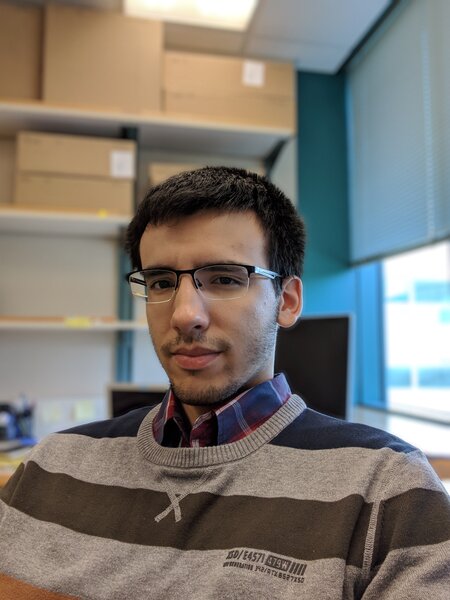
Enes K. Ergin, PhD
Bioinformatician & Systems Engineer
Founder at Zenteomics - GitHub
Consulting Bioinformatician for labs at BCCHR, VGH, and more
PhD, Bioinformatics. University of British Columbia
I'm a bioinformatician in Vancouver. Most of my work is quantitative proteomics, often at the proteoform level and with pediatric cancer data. Zenteomics, my one-person practice, has added gene fusion calling from RNA-seq. What ties it together is resource use: large-scale analysis on smaller hardware, personal laptops included.
Research interests
-
Quantitative proteomics & proteoform biology
Methods for finding proteoforms, the cleaved and modified forms of a protein that a protein-level average hides.
ProteoForge J. Proteome Res., 2026 · SQuAPP Bioinformatics, 2022 · N-termini proteoforms (Weng et al.) Mol. Cell. Proteomics, 2019 · PhD thesis UBC, 2025 -
Statistical methods
Statistics that hold up when values are missing, and equivalence tests that can show a protein did not change.
QuEStVar J. Proteome Res., 2024 -
Pediatric cancer multi-omics
Proteomics and phosphoproteomics of childhood leukemia, xenograft models, and the PROFYLE precision oncology program.
PROFYLE (Barnabas et al.) EMBO Mol. Med., 2025 · ALL proteomics (Lorentzian et al.) Nature Comms., 2023 · PDX models (Uzozie et al.) J. Exp. Clin. Cancer Res., 2021 -
Transcriptomics & gene fusions
Gene fusion calling from RNA-seq for clinical labs, through Zenteomics. FRAMEFusion, a pipeline for FFPE tissue, is in development.
-
Fast tools with a small memory footprint
Mostly Zig. zmz reads mzML in 2.8 MiB of memory where OpenMS peaks at 597 MiB, mzDiff compares a 5.3 GiB Astral run in 17.1 s with 20.5 MB, and HarmonizePy runs batch correction 54 to 266 times faster than single-core HarmonizR.